Explore our high-performance copper solutions developed to satisfy strict global industrial standards.
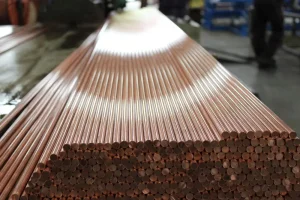
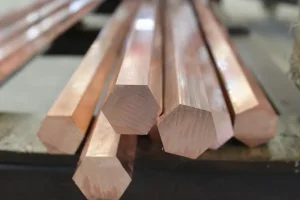
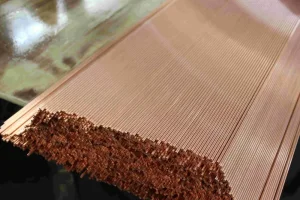
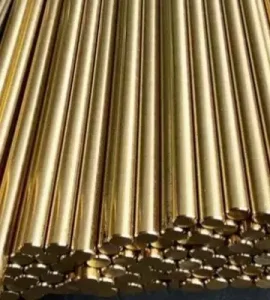
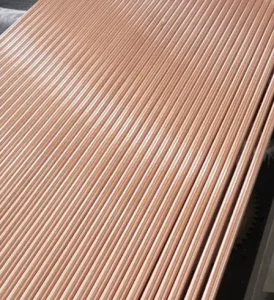
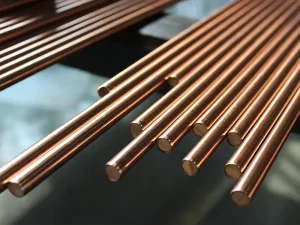
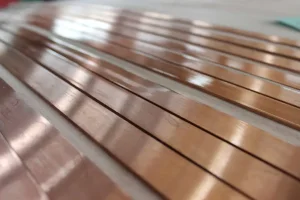
Electrolytic Tough Pitch (ETP) Copper, designated globally as UNS C11000, represents the baseline standard for electrical and thermal conductivity in global engineering. Consisting of a minimum of 99.90% pure copper, this metal is refined through electrolysis to achieve a conductivity level of 100% to 101% IACS (International Annealed Copper Standard).
C11000 is characterized by its controlled oxygen content (typically 0.02% to 0.04% in the form of cuprous oxide), which acts as a purifying agent during melting, binding with impurities to ensure high electrical capability. This structure makes C11000 the ideal choice for massive electricity distribution, power conversion, precision stamping, and EV architecture.
As a leading OEM C11000 copper supplier, Sichuan Kepai New Materials Co., Ltd. combines advanced continuous casting and rolling technologies to manufacture ETP Copper that surpasses standard mechanical characteristics, allowing for seamless integration into high-stress applications.
| Property | Metric Value | Imperial Value |
|---|---|---|
| Density | 8.89 g/cm³ | 0.321 lb/in³ |
| Electrical Conductivity | 101% IACS | 58.6 MS/m |
| Thermal Conductivity | 388 W/m·K | 226 Btu/ft·hr·°F |
| Melting Point | 1083 °C | 1981 °F |
| Tensile Strength (Hard) | 310-380 MPa | 45-55 ksi |
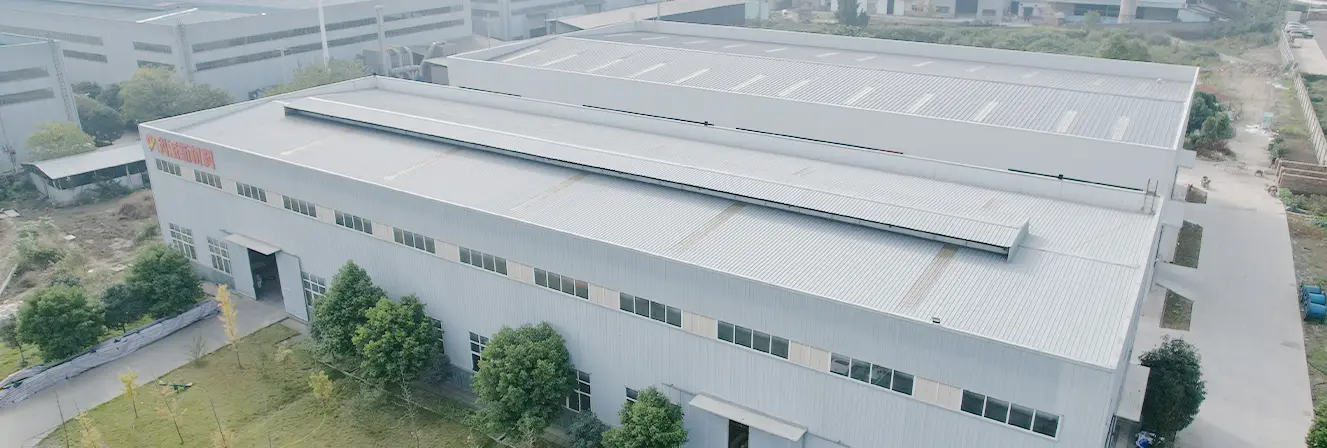
Established in May 2017, Sichuan Kepai New Materials Co., Ltd. has developed into a major industrial partner specializing in the R&D, production, and supply of high-conductivity, high-strength copper alloys and premium pure copper materials, including C11000 ETP Copper.
Operating from a 29,000 square meter factory space, we employ modern quality management frameworks to manufacture products that satisfy tough international parameters. Our capacity is anchored in technical innovation, holding over 30 patents and maintaining environmental and management certifications such as ISO 9001:2015, ISO 14001:2015, and OHSAS 45001:2018.
We serve over 1,000 clients globally, supplying to critical sectors such as new energy vehicles, aerospace, ocean engineering, and high-frequency connectors, cementing our position as a trusted OEM supplier on a global scale.
How Sichuan Kepai combines industrial cluster advantages with high-end metallurgy to offer superior value.
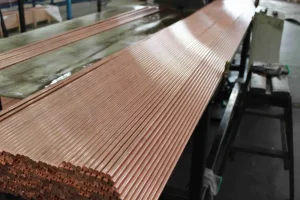
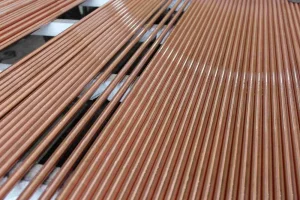
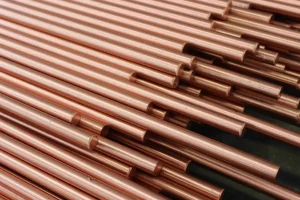
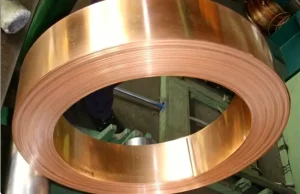
Our processing lines rely on induction melting and continuous casting to maintain oxygen concentrations precisely between 0.02% and 0.04%. This limits oxidation and impurities, preventing the premature crystallization of trace elements that could impair the conductivity of C11000 copper plates, foils, and rods.
Every batch of our OEM ETP Copper conforms strictly to ASTM B152 (for copper sheet, strip, plate, and rolled bar), ASTM B187 (for bus bar, rod, and shapes), and European standard EN 13601. High-frequency eddy current tests and spectroscopic inspections ensure zero structural defects before shipment.
By using direct supply channels and modern processing frameworks, we reduce logistical friction and production waste. This enables us to offer competitive pricing without compromising the mechanical integrity or high-conductivity metrics required by our global partners.
C11000's evolving role in next-generation industrial architectures and high-growth technologies.
The global shift toward electric transportation has triggered a demand surge for reliable conductive materials. In an EV, every microsecond of energy transition counts. C11000 ETP Copper serves as the foundational core for busbars, battery connectors, charging pins, and high-voltage distribution lines.
Its high thermal capacity allows it to handle sudden heat spikes during rapid-charging cycles, while its mechanical ductility enables complex, custom geometries inside tight battery pack configurations without cracking or tearing.
High-performance computing (HPC) nodes and AI training clusters require immense power inputs at low voltages, translating to extremely high currents. C11000 bus bars are utilized to minimize energy loss over short-distance transmission lines within server racks, helping reduce power consumption and cooling demands.
Additionally, modern smart grids rely on C11000 for transformers, switches, and high-capacity cables. The material's low electrical resistance helps cut transmission losses and carbon footprints across long-distance distribution networks.
Due to its high purity and the formation of a natural protective oxide layer, ETP Copper exhibits good resistance to atmospheric corrosion and biofouling. This makes it highly valued in marine environments for heat exchangers, condenser tubes, and piping systems handling seawater, as well as grounding systems in coastal substations.
Our modern laboratory tracks chemical purity down to the parts-per-million (PPM) level. We measure key performance metrics including:
Our C11000 ETP Copper and specialized alloys are deployed in challenging industrial applications worldwide:
Verify compliance, chemistry composition, and global equivalents for engineering specifications.
To help you choose the right copper alloy for your projects, the table below outlines the strict chemical composition requirements of UNS C11000 ETP Copper compared to other variants in our lineup.
| Element | C11000 (ETP) Weight % | C10200 (OF) Weight % | C12200 (DHP) Weight % |
|---|---|---|---|
| Copper (Cu) | ≥ 99.90% | ≥ 99.95% | ≥ 99.90% |
| Oxygen (O) | 0.02% - 0.04% | ≤ 0.001% | - |
| Phosphorus (P) | - | - | 0.015% - 0.040% |
| Lead (Pb) | ≤ 0.005% | ≤ 0.005% | - |
| Impurities Total | ≤ 0.10% | ≤ 0.05% | - |
Processing Warning: ETP C11000 is susceptible to hydrogen embrittlement when heated above 370°C (700°F) in reducing atmospheres. Under these conditions, hydrogen diffuses into the copper and reacts with the cuprous oxide (Cu₂O) inclusions to form high-pressure water vapor ($H_2O$), creating internal micro-cracks. For applications involving high-temperature brazing or welding in hydrogen-rich atmospheres, we suggest our Oxygen-Free Copper series (C10100 / C10200).
Technical guidance and answers regarding ETP C11000 specification, applications, and logistics.
The core difference lies in the oxygen content. C11000 ETP (Electrolytic Tough Pitch) Copper contains 0.02% to 0.04% oxygen, which helps maintain high electrical conductivity (min 101% IACS) by binding impurities. However, this oxygen can cause hydrogen embrittlement when exposed to reducing atmospheres above 370°C. C10200 Oxygen-Free (OF) copper has an oxygen level below 0.001%, making it highly resistant to hydrogen embrittlement and ideal for vacuum electronics, high-temperature brazing, and advanced welding.
Yes, ETP Copper C11000 features excellent cold workability and high ductility. It is highly suitable for cold heading, blanking, rolling, bending, and deep drawing. When ordered in an annealed temper (O60), it handles severe deformation without cracking, which is essential for manufacturing complex electrical lugs, terminals, and shield casings.
Our quality control department utilizes OES (Optical Emission Spectrometry) to verify trace chemistry composition down to the ppm level. We also measure conductivity using eddy-current methods and perform tensile, yield, and elongation testing to ensure mechanical properties match your blueprint specifications. Every shipment is accompanied by a comprehensive Mill Test Certificate (MTC) conforming to EN 10204 3.1.
Sichuan Kepai provides a range of finishing processes to match specific application demands. This includes precision slitting, surface polishing, passivation to prevent oxidation, tin plating, nickel plating, or silver plating to enhance corrosion resistance and solderability in high-humidity electrical installations.
From pure copper foils to high-conductivity bus bars and custom alloys, Sichuan Kepai delivers certified metallurgical solutions to streamline your global production lines.
Send Inquiry NowExpand your sourcing efficiency by exploring our specialized tellurium, beryllium, and phosphor copper products.
 Kepai New Material