Explore our industrial-grade, high-conductivity materials engineered for extreme thermal, electrical, and wear environments.
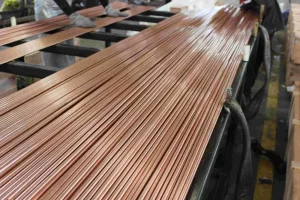
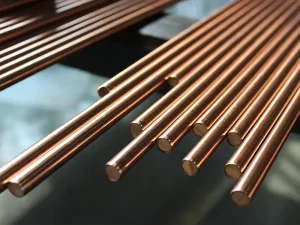
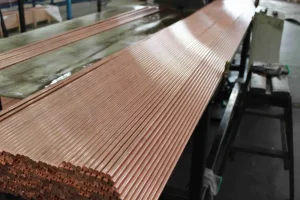
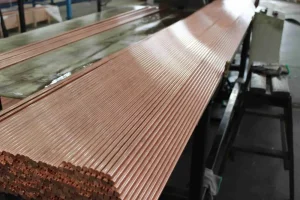
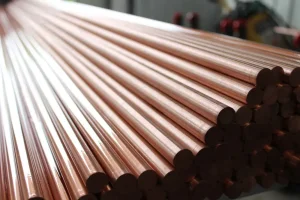
Understanding ETP (Electrolytic Tough Pitch) Copper in its Half-Hard Temper Condition
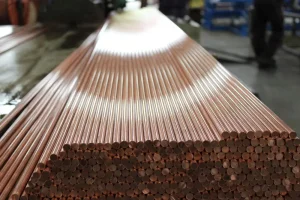
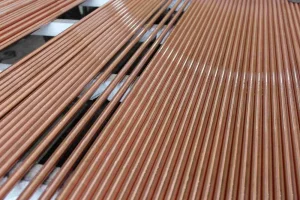
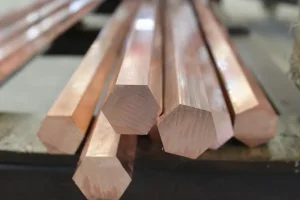
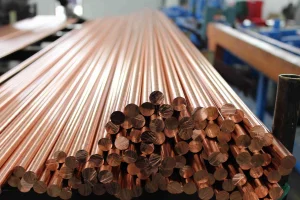
Copper C11000, also universally recognized as Electrolytic Tough Pitch (ETP) Copper, represents the baseline of high-conductivity engineering materials. Containing a minimum purity of 99.90% copper with a strictly controlled oxygen content (ranging between 100 to 650 ppm), C11000 represents the optimal balance of raw material cost-effectiveness and exceptional transmission performance. The H02 temper designation signifies that the copper has been cold-worked to a half-hard state, delivering a significant boost to its yield and tensile strength without severely impacting its electrical conductivity or cold formability.
Copper C11000 H02 maintains an electrical conductivity of at least 100% to 101.5% IACS (International Annealed Copper Standard) at 20°C. Its thermal conductivity remains exceptionally high at approximately 391 W/(m·K), making it the ideal standard for high-current busbars, switchgear contact blocks, and rapid thermal transfer assemblies in electric vehicle powertrains.
Why specify the H02 (Half-Hard) temper instead of the fully annealed (O60) or extra-hard (H04) tempers? The H02 temper provides the exact mechanical stiffness required to support heavy structural weights (such as long spans of electrical bus ducts) without sagging, while still retaining a high elongation factor (~15% to 25%). This permits mechanical forming, precise CNC bending, and punching operations without cracking or micro-stress cracking.
| Property Parameter | C11000 H02 (Half-Hard ETP) | C10100 (OFC Oxygen-Free) | C11000 O60 (Annealed ETP) |
|---|---|---|---|
| Min. Copper Content (%) | 99.90% | 99.99% | 99.90% |
| Electrical Conductivity (% IACS) | 100.5% - 101% | 101% - 102% | 101% |
| Tensile Strength (MPa) | 260 - 325 MPa | 220 - 260 MPa | 205 - 245 MPa |
| Yield Strength (0.2% Offset, MPa) | 195 - 260 MPa | 60 - 90 MPa | 60 - 75 MPa |
| Rockwell Hardness (HRB/HRF) | 75 - 90 HRF | 35 - 55 HRF | 30 - 45 HRF |
| Hydrogen Embrittlement Risk | Moderate to High (in reducing atmospheres) | None | Moderate to High |
Fulfilling Global Infrastructure Demands with State-of-the-Art Alloy R&D
Quality management system certification governing all stages of smelting, rolling, and drawing.
Complete compliance with environmental management protocols, driving green and sustainable production.
Occupational health and safety standards that protect our operators and guarantee production continuity.
The Pivotal Role of C11000 H02 in Modern Electric and Renewable Energy Grids
The rapid decarbonization of the global economy has initiated a massive demand wave for premium high-conductivity copper. ETP C11000 H02 stands at the epicenter of this structural shift. Within modern smart grids and high-voltage transmission networks, minimizing line losses (resistive I²R losses) is no longer just an environmental goal; it is a critical regulatory and economic metric.
Modern DC fast chargers (exceeding 350 kW capacities) utilize C11000 H02 for high-current copper busbars and cooling connector pins. The H02 temper prevents physical distortion under high thermal cycling.
Battery Energy Storage Systems (BESS) require extensive copper interconnects. C11000 H02 sheets are stamped into structural battery module jumpers that handle massive current draw reliably over decades.
Avionics and airborne power distribution blocks require high mechanical fatigue resistance without compromising on high electrical performance. Our specialized tempering control meets these exact criteria.
Across the Americas, the European Union, and rapidly developing regions in the Asia-Pacific, structural upgrades to existing municipal power grids are driving an unprecedented deficit in high-purity copper processing capacity. Working directly with an integrated manufacturer like Kepai ensures global companies secure a stable supply of fully characterized, non-porous ETP copper.
Practical Engineering Deployments Across Primary Geographies
Copper alloys must adapt to diverse environmental demands and local technical standards. Here is how C11000 H02 is integrated dynamically into three key regional markets:
In accordance with IEEE and NEMA standards, C11000 H02 is the preferred metal for medium-to-low voltage switchgear enclosures, custom busbar runs, and high-ampacity electrical panels. The physical stability of the H02 temper allows engineers to design thin, lightweight structural components that reliably support high-current distributions without deflection.
Within the EU's strict environmental regulations, Kepai's C11000 H02 is highly sought after for photovoltaic inverter contact plates and offshore wind turbine generator rings. The high-purity composition ensures no hazardous element outgassing, full RoHS compliance, and perfect adaptability to severe saline offshore conditions.
Across high-speed rail systems, precision semiconductor lead frames, and micro-switch housings in APAC, C11000 H02 acts as the structural conductive backbone. The cold-worked half-hard temper provides superb punching and stamping performance, minimizing die wear and maximizing manufacturing yields on high-speed stamping presses.
Innovating the Next Generation of High-Conductivity Copper Metallurgy
As power demands scale upwards and electronic devices shrink, conventional ETP copper faces fundamental material science limits. Kepai New Materials is executing an aggressive metallurgical roadmap to stay ahead of future technology requirements:
By optimizing the roll-reduction ratios and using continuous horizontal casting in a micro-controlled reduction chamber, we minimize grain boundaries and orient them along the path of current flow, maximizing actual practical conductivity close to theoretical limits.
Deploying Sichuan’s vast, clean hydroelectric resources, Kepai is moving toward a near-zero carbon footprint process for melting and rolling operations. This guarantees downstream OEMs can meet their Scope 3 greenhouse gas reduction metrics easily.
Developing trace-doped hydrogen-resistant ETP equivalents. By binding oxygen trace impurities at the sub-atomic level with specialized non-conductive neutralizing agents, we aim to deliver copper that resists hydrogen embrittlement while retaining 100%+ IACS performance.
The Unique Strategic Geographies and Operational Strengths of Kepai
Managing global procurement in volatile macroeconomic conditions requires a highly resilient supply partner. Located strategically in Sichuan, Sichuan Kepai New Materials Co., Ltd. leverages powerful geographical and operational advantages:
Zero-Risk Integration for Global Engineering and Procurement Teams
We understand that specifying an international supplier involves strict regulatory challenges. To address this, Kepai provides comprehensive material traceability reports and complies fully with major international standards:
Our C11000 H02 sheets, plates, strips, and bus bars meet or exceed all standard specifications outlined by the American Society for Testing and Materials.
Our alloys undergo third-party chemical laboratory analysis to verify zero contamination from restricted heavy metals, fully compliant with modern environmental directives.
Every shipment is accompanied by a complete chemical profile report, mechanical strength testing metrics, and certified Eddy Current testing for sub-surface integrity.
Crucial Engineering and Procurement Insights About C11000 H02 Copper Alloys
Browse our complete catalog of industrial alloys, including beryllium, lead-bronze, and free-cutting sulfur-copper varieties.
Struggling with high engineering tolerances, customized busbar bending specifications, or global logistic costs? Contact Kepai’s metallurgy advisory department today to receive tailored support and custom manufacturing estimates.
Send Immediate Inquiry Kepai New Material